I’ve spent the whole morning going through my RSS feed, my Telegram channel, LinkedIn, a couple of technical newsletters and two or three sites I read every day… and out of every ten headlines in front of me, eight mention AI somewhere. I’m not exaggerating. I just counted them. And the curious part is that it no longer surprises me: I accept it as part of the scenery, the same way you accept the background hum of a badly adjusted air conditioner. So, taking advantage of the fact that it’s Saturday and I feel like writing, I’d like to open up a small debate about this and hear what you think.
Three years ago, writing an article about AI here on Sinologic was almost exotic. I can proudly say that back in 2018 we were already talking about AI in the VoIP environment, and it’s no surprise that, with the advances we have today, we’ve already published about Vosk vs Whisper, about Linux kernel exploits found by AI, about the state of VoIP in 2026 with AI baked in everywhere, and quite a few more. And even so, even for me, someone who turns this over in his head every week, the speed at which it has reached absolutely everything still amazes me.
So it’s about time we sat down for a while to think about what’s really happening, beyond the easy headline and the “magic prompt that will change your life“.
The problem isn’t AI. The problem is the speed.
Like any technology in development, it needs a period of stabilization, just as happened with the first laptops, the first mobile phones, the internet… but AI didn’t arrive little by little, it arrived all at once, with no instruction manual and without waiting for anyone to be ready. In less than three years we’ve gone from models that did curious things with text to tools that draft a contract for you, generate a reasonably decent Asterisk dialplan, build you a React frontend in fifteen minutes, translate a call in real time with reasonable latency, and hold a conversation in a cloned voice that many customers wouldn’t be able to tell apart from a human agent. And that’s without getting into what’s coming next.
Does AI do it better than we do ourselves? It depends on what. For many things, not yet. But in speed, always. And that, in the real world, changes everything.
This is where we fall into the trap: we spend all day comparing the quality of AI with human quality, when the question that really matters is a very different one. It’s not “does it do it better?”. It’s “does it do it well enough to do it ten times faster and be able to correct it in record time?”. And to that question, today, the majority answer is yes. Even if it stings.
The 10x productivity is real. But it comes with fine print.
I say this from first-hand experience, because I use it daily. Tasks that used to take me an entire afternoon I now dispatch in minutes. A report that required a couple of hours of data measurement now comes out in thirty minutes. A migration script between databases that at another time would have had me searching Stack Overflow for hours now comes out in one go with Claude or with Copilot. I’m not going to pretend I don’t use it, because I do, and because it works. For now, I still maintain that AI is an accelerator, not a replacement.
But there’s something almost nobody mentions when they talk about the mythical “10x productivity“: AI also multiplies the mistakes you would never have made yourself. And I’m not talking about mistakes like “I forgot to close a bracket“. I’m talking about new mistakes, strange mistakes, mistakes made by someone who has stopped understanding what they’re doing because they delegated that part.
I see it clearly in development, but I also see it in any other trade. The programmer who delegates all the logic to the model of the moment. The writer who publishes without rereading what they generated. The designer who accepts the first proposal because “after all, it’s free“. AI is extraordinarily good at generating plausible answers. The problem is that “plausible” and “correct” are not the same thing, not by a long shot, and to tell them apart you need judgment. And judgment, bad luck, is only developed by doing things the slow and difficult way. Precisely the way AI comes to spare us.
Vibecoding: when programming turns into guessing blindly
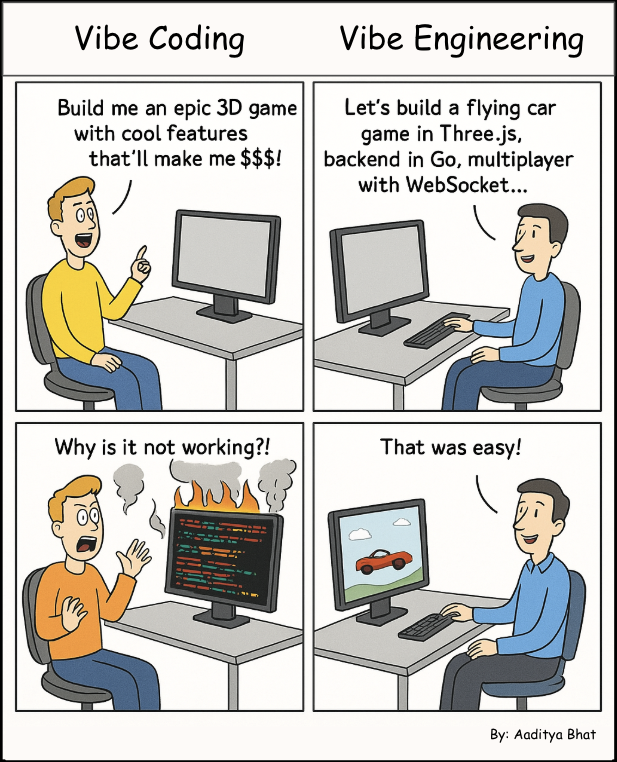
There’s a term that’s becoming fashionable in development circles and that perfectly defines one of the most serious risks in this whole story: vibecoding. The literal translation would be something like “programming by following the vibes“. You ask the AI for the code, you run it, you see that it works, and onward. Without understanding what it does. Without knowing why it works. By pure intuition.
The problem isn’t using AI to program. I do it, you do it, everyone who looks to the future rather than the past does it. The problem is doing it blindly. Because code that works locally on a Tuesday morning may have a critical vulnerability, may be consuming three times the RAM it needs, may be opening a port it shouldn’t, or may break in production at the first edge case nobody anticipated. And if the person who clicked “accept” doesn’t understand what they have in their hands, they won’t detect it, let alone fix it when it happens. And when they ask the AI again how to fix it, it’s very possible the next answer makes things worse. I’ve seen that several times already, and not on small projects.
Real cases I’ve been seeing over the past year: AI-generated Asterisk dialplans with conditional jumps that nobody on the team understands and nobody dares to touch. Integration tests that passed green because the tests were also generated by the AI… and were also wrong. PBX-to-cloud migrations where half the configuration worked by chance. All of that, in production.
My personal rule, in case it helps: AI can generate the first draft of anything for me, but it doesn’t touch a production server until I’ve read line by line what it wrote.
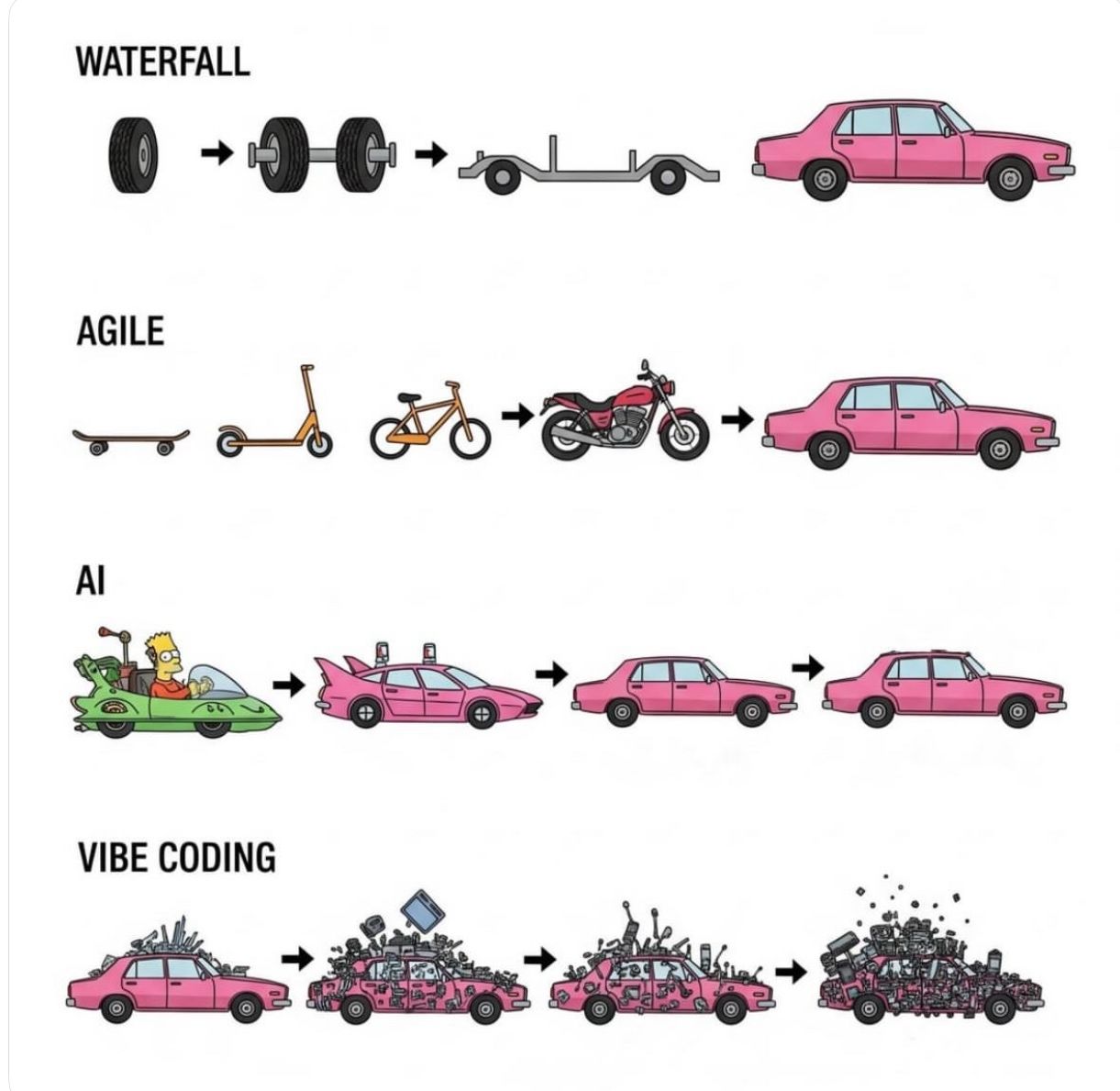
What will the future of programming look like in 5 years? My honest (and slightly uncomfortable) opinion
People ask me this a lot lately and I always answer the same thing. I don’t know for certain, but I have a fairly well-formed intuition about where we’re heading.
In five years, most of the “plumbing” code (integrations, basic CRUD, forms, scaffolding, repetitive configurations) will be generated by AI almost autonomously. It practically already does. The only thing that will change is that nobody will question it, just as today nobody questions Google Maps telling them which way to go.
What will not disappear (and here’s my strong bet) is the need for someone who understands what that code has to do, why, with what constraints, with what security implications, and who is capable of validating that what the machine generated is really what the business needs. The programmer of the future won’t be “the one who writes code“. They’ll be “the one who knows enough to supervise, validate and correct what the AI generated“. Which is not the same thing. Not by a long shot. And it requires understanding the craft much better than now, not worse. It will be like having seniors in charge of several juniors.
But here comes the uncomfortable question, the one almost nobody wants to ask out loud: where are those seniors going to come from? Because historically seniors come from juniors. And the junior is trained by doing precisely the plumbing code we’re now about to take away from them. How does someone who has never had to write the loop by hand learn to debug a concurrency error? How does someone who has never had to suffer the consequences of a badly thought-out architecture learn to design one? I don’t have it clear, and it worries me.
I have the feeling that in five or six years we’re going to run into an enormous gap: lots of profiles capable of pasting prompts and accepting suggestions, and very few capable of getting their hands into a system when it breaks at three in the morning. And the latter will be worth their weight in gold. Literally ten times more productive than the rest… and a hundred times more valuable. Perhaps programmers over 50 will go from being the ones nobody wants to the ones everybody craves.
The generation that no longer writes without AI
But this isn’t just a programming thing. Far from it. Recently a friend who works in education told me something that’s been turning over in my head for weeks.
When he gives his students aged 15 to 18 a handwritten exam, the old-fashioned kind, with paper and pen and a topic to develop, the result in many cases is downright bleak. They go blank. They don’t know what to write. Dozens of spelling mistakes. Sentences that make no sense. Paragraphs that start and go nowhere. They fall apart, literally.
And yet, those same students, when they hand in homework from home, present well-structured texts, with rich vocabulary, sometimes with a level of depth you’d expect from higher courses. The difference, of course, is ChatGPT.
These days practically anyone under 18 uses AI for anything that involves putting words on paper: an email, an essay, an application, a user manual, a forum reply. Not necessarily to cheat, but because they’ve stopped going through the process of “how do I say it myself?“. And that process (the one of finding your own words, building the argument from scratch, making the effort to articulate a complex thought) is not an accessory. It is exactly the process that develops critical thinking and the ability to communicate with precision. Without it, those capabilities don’t form.
What’s atrophying isn’t spelling. Spelling is the least of it. What’s atrophying is the ability to think clearly and express it without crutches. And that, taken into a professional environment, is a very serious and very concrete problem.
The question I’m already asking myself, and that many of you reading this will be asking too, is the practical one. Do you hire a 20 or 22-year-old kid fresh out of vocational training or university who wrote their entire degree with ChatGPT by their side? How do you tell, in an interview, the one who knows how to think from the one who only knows how to ask? Which technical tests make sense today and which ones have become obsolete? I don’t have all the answers, but I am clear that the hiring processes of the coming years won’t look anything like those of the last twenty.
The professional future with AI is going to be strange. Very strange. There will be profiles that could never have existed ten years ago and that now become completely viable. And there will be profiles that existed forever and that are going to disappear, because they did exactly what AI does better, faster and without complaining about the overtime. The uncomfortable question nobody wants to ask out loud, and the one I’ll keep for myself too, is: which of the two groups am I in?
So what now?
AI isn’t going to disappear. Nor is it going to slow down. The models will keep improving, prices will keep falling (until they stop falling, and on that day we’ll have to talk about the other bubble, the economic one, which I already wrote about a couple of years ago right here), and integration into everyday tools will remain inevitable. Whoever wants to get off, let them get off. But the train isn’t going to wait. I know programmers who don’t directly say they disagree with AI, but they’re not convinced about working with it; they prefer to keep doing things by hand, and that’s respectable, it’s their professional future, and just as they decided to become a programmer instead of a plumber, they’ll have to jump the fences (or the walls) they find along the way.
What is in our hands is to be smarter than the headline. To use AI where it really helps. To know when it’s better to do it by hand. And, above all, not to confuse “I can delegate this to a model” with “I should delegate this to a model“. The productivity it offers is real, but so is the atrophy it causes in those who use it without judgment. And the second is far harder to reverse than the first.
We’ve been here for more than twenty years watching technologies come and go. Some promised to change the world and ended up as a conference t-shirt. Others changed it without anyone raising the curtain. AI clearly belongs to the second group, and that’s why it deserves us looking at it with our eyes wide open: without the enthusiasm of someone who has never seen a bubble before, but also without the skepticism of someone who never wanted to believe in anything new.
I’ll keep using it, criticizing it, wrestling with it and learning from it. As with everything else in this craft. Coffee in hand, editor open, and common sense within reach just in case.
And now it’s your turn: are you seeing the same thing? Do you have vibecoding cases that have blown up in your face? Are you already hiring, or firing, based on how people relate to AI? Tell us in the comments or on the Telegram channel, because these articles are here to open a conversation, not to close it.

Join the Sinologic community
Create your free account and join the conversations about VoIP, Asterisk, Kamailio and IP telephony.
Your experience matters
The best articles are born from good discussions.