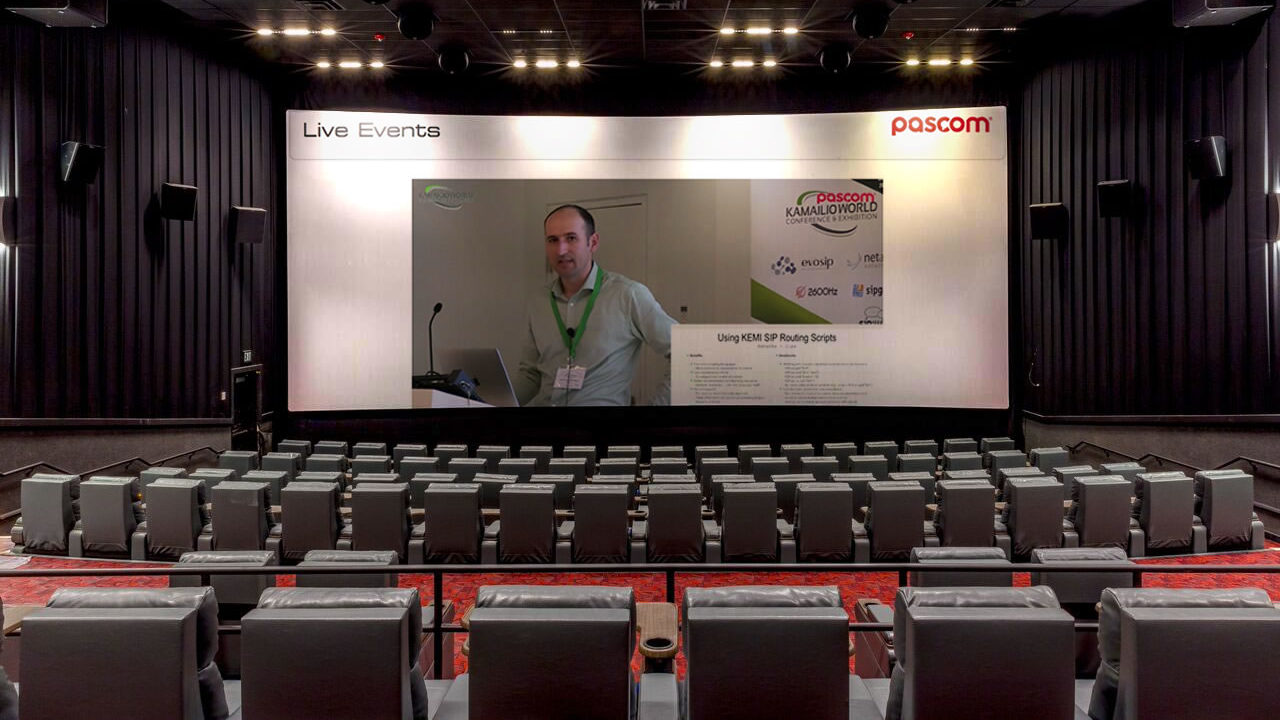
If you’ve been around the IP telephony and VoIP world for a while, you already know that KamailioWorld is, without exaggeration, the most important technical conference of the year around open source real-time communications. In 2026 things have an extra touch of excitement: Kamailio turns 25. Yes, a quarter of a century since what started out being called SER (SIP Express Router) in the labs of the Fraunhofer FOKUS Institute in Berlin became the backbone of IP telephony across half the world.
The conference takes place on 7 and 8 May 2026 in Berlin, just a few metres from Alexanderplatz, and comes this time with an agenda that, if you read it carefully, gives you a pretty clear picture of where the industry is heading. Let’s go through it.
Kamailio 2026: technical news and the eternal scalability debate
Daniel-Constantin Mierla, co-founder of the project, opens the event with the classic “last year in review”: news from Kamailio v6.0 and v6.1, what has changed, what’s coming. And he closes the second day with a talk on something that has been on the table for some time: the new multi-threading model for UDP and TLS as an alternative to the classic multi-process. For those with SIP infrastructures under pressure, this is one to take note of.
As is traditional, there will also be an open “Ask Me Anything”-style session with the project’s main developers: Mierla, Victor Seva, Federico Cabiddu, Andreas Granig, Fred Posner, Henning Westerholt and Alexandr Dubovikov. If you have doubts about how to scale, how to secure or how to do certain things with Kamailio, this is the moment to ask without filters.
Artificial Intelligence and VoIP: it’s no longer the future, it’s the present
If there’s a common thread running through the KamailioWorld 2026 agenda, it’s the integration of AI into voice infrastructure. And what’s interesting is not that it shows up, but how it shows up: not as a promise, but as real use cases, in production, with specific numbers.
Andreas Granig (Sipfront) explains step by step how to build an open source voice bot from scratch using BareSIP, comparing the two main current approaches: the speech-to-speech models from OpenAI or Gemini versus the classic chained STT + LLM + TTS approach. If you’re thinking of building something like this, this talk will save you many hours of trial and error.
Varun Singh (Daily.co) goes a step further and presents a real architecture of AI voice agents over SIP using Pipecat.ai with Kamailio: tens of thousands of calls per second, with peaks of one million SIP calls in an hour. That this is no longer science fiction says a lot about the state of the art.
Lorenzo Miniero (Meetecho, author of Janus WebRTC) presents Juturna, a modular open source framework for building real-time AI pipelines over VoIP/WebRTC audio and video streams. The idea is elegant: instead of processing pre-recorded audio, Juturna works with the live stream, with everything that entails in terms of latency. They already use it in production for real-time transcription of IETF meetings.
And perhaps the most “near future” talk of the whole conference: Mack Hendricks (dOpenSource) explains how they have exposed Kamailio to conversational AI tools —ChatGPT, Claude— via MCP (Model Context Protocol). In other words: the SIP server as a tool that an AI can query and control autonomously. If this doesn’t seem relevant to you, it might deserve a second read.
VoIP security: the same old problems, with new tools
Security in SIP environments has been a problem since SIP existed, and KamailioWorld 2026 dedicates a good amount of space to it.
Sandro Gauci (Enable Security) presents DVRTC (Damn Vulnerable Real-Time Communications): a platform built on Kamailio, Asterisk and RTPEngine that is deliberately insecure, designed so that security teams can practise real attacks —SIP registration hijacking, authentication bypasses, RTP injection— without breaking anything in production. They also use it as a honeypot to study real attack patterns. That we still need this in 2026 still says something about the state of VoIP security.
Fred Posner (APIBan/LOD) reviews the news in APIBAN, the free service that blocks malicious IPs on SIP and WebRTC infrastructures. If you don’t know it and you have Kamailio or Asterisk exposed to the internet, you should. New open source clients and improved integrations with Kamailio are the main course of this session.
Distributed architectures: the day-to-day of those running VoIP at scale
Elena Darriba (CloudTalk) presents a production solution for something trickier than it seems: delivering mobile calls via asynchronous push notifications on a distributed, auto-scalable Kamailio cluster behind a load balancer, with WebSocket connections in between. Session affinity problems in these environments are real, and the solution she proposes is worth paying attention to.
Viktor Litvinov (Net2Phone) does a deep-dive into the KDMQ (Kamailio Distributed Message Queue) module: how to use it to achieve real fault tolerance, redundancy and security between distributed nodes.
And on the more experimental side, Jonathan Kandel (Cellact) proposes removing the centralised push notifications server by storing Firebase and APNs signing credentials in a confidential smart contract on Oasis Sapphire. Kamailio triggers the flow, signing happens on-chain, and no intermediary server touches the credentials. It may sound odd, but the problem it’s trying to solve —the dependency on centralised infrastructure as a single point of failure and risk— is completely legitimate.
Standards that will matter: VCon, RTT, NG112 and 5G
Some of the most important talks at KamailioWorld 2026 aren’t the flashiest, but they’re the ones that set the medium-term direction.
Dan Jenkins (Nimble Ape) presents VCon (Virtual Conversations), an IETF standard with RFCs published in 2025 that defines a signed, portable JSON container for all the data in a conversation: participants, metadata, transcriptions, AI analysis, recordings. A kind of vCard, but for calls. With direct integration modules in Kamailio. When this matures, it’s going to change how voice traffic is audited, analysed and monetised.
Henning Westerholt (Gilawa) tackles the implementation of RTT (Real-Time Text) in Asterisk and other open source VoIP platforms. RTT —real-time text over voice calls, according to the T140 protocol over RTP defined in RFC 4103— is now a regulatory requirement in the EU for electronic communications services. It’s not optional.
Wolfgang Kampichler (Frequentis) provides a state of the art of NG112/NG911 as of 2026. With the European Accessibility Act pointing to 2027 and the FCC with its Phase 2 requirements under way, the migration to next-generation emergency services is no longer reversible. Kamailio as an ESRP (Emergency Service Routing Proxy) at the centre of these architectures is one of those use cases few people see but that saves lives.
Elena-Ramona Modroiu (TU Berlin), co-founder of Kamailio itself, presents how to set up a private 5G Standalone network using only open source software and affordable hardware. For those who have been following this for a while, knowing that it’s now feasible at this level is a milestone.
Roman Onic (Kontron Transportation) explains the implementation of the IMS Rf charging interface with Kamailio in critical communications systems for railways, replacing analogue radio and GSM-R. One of those projects that proves that open source VoIP is much more present in critical infrastructure than most imagine.
Other sessions not to be missed
Giacomo Vacca (SignalWire) presents SignalWire’s modern RTC control layer: SWML to define call flows declaratively, the Relay SDK, Call Fabric and the AI Agents SDK in Python. All built on FreeSWITCH and Kamailio. A good view of how the programming interface over classic telephony is being modernised.
Alexandr Dubovikov (QXIP) presents Homer SIPCapture 11, with significant performance and scalability improvements for monitoring large-scale VoIP networks. If you have an environment with serious SIP traffic volume, Homer is practically mandatory.
Dan Bogos (ITSysCom) talks about CGRateS’s advanced routing system and its integration with Kamailio for provider selection. Iurii Gorlichenko debunks the myths about when to use KEMI and when not to. Tim Panton (|pipe|) gives a tour of the strangest and most recent Chromium capabilities for real-time media. And Markus Monka (Sipgate) organises the “Kamailio Code Challenge”: real configuration snippets submitted by the community that the audience has two minutes to decipher. Whoever solves it wins; if no one can, the one who submitted it wins. It’s as simple and as good as it sounds.
As a historic finishing touch, a special panel will bring together Dorgham Sisalem, Jiri Kuthan, Jan Janak, Dragos Vingarzan and James Body to review 25 years of the project’s evolution, from the early days of SER to today.
What all this tells us about the future of VoIP
Reading the KamailioWorld agenda is always a fairly reliable way of knowing where the industry is going in the next two or three years. And what this edition says is quite clear.
The integration of AI into IP telephony is already happening, not in the future. AI voice agents over SIP, real-time audio processing pipelines, the SIP server as an interface controllable by language models… all of that is in production or about to be. Open source is leading the way.
Call data is going to be as important as the calls themselves. VCon is the clearest symptom: the industry is building the infrastructure to turn each conversation into a structured, auditable and analysable asset. Compliance, quality, business, AI… it all depends on it.
Security is still the Achilles’ heel. That in 2026 we still need a platform like DVRTC to practise attacks against the same old vectors —hijacking, RTP injection, authentication bypasses— is a signal worth not ignoring. If you have SIP infrastructure exposed, update, audit and use APIBAN.
Critical infrastructure is moving to open source VoIP quietly but decisively. NG112, IMS for railways, private 5G networks… what used to be the territory of proprietary vendors is being replaced by open source stacks with Kamailio at the centre. European regulation is accelerating this.
And open source is still where real innovation happens. Kamailio, FreeSWITCH, Asterisk, Janus, Homer, RTPEngine… this conference, year after year, is the best demonstration that the most important projects in the world’s telecommunications infrastructure are maintained by specific people, with first and last names, who get together for two days in Berlin to share what they’ve been doing.
If you can go, go. If you can’t, follow the KamailioWorld YouTube channel: they publish the videos of the talks after the event and they’re reference material. If you want to go through the rest of the industry event calendar, we have an article with all the VoIP, telephony and WebRTC events of 2026. Registration is open at kamailioworld.com.


Join the Sinologic community
Create your free account and join the conversations about VoIP, Asterisk, Kamailio and IP telephony.
Every opinion counts
Your comment could solve someone else's question.