
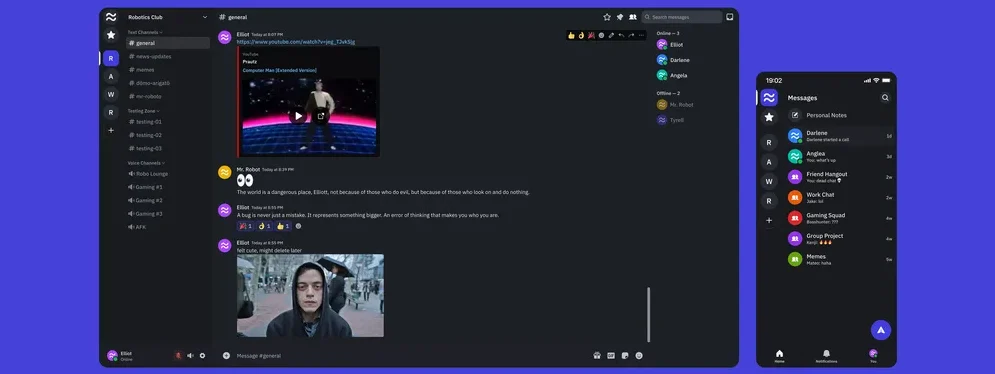
Fluxer is an open source instant messaging and VoIP platform, self-hostable and free, designed as a direct alternative to Discord. Distributed under the AGPLv3 license, it has more than 125,000 active users in production and is approaching 8,000 stars on GitHub. It is, in practice, the most complete open source clone of Discord available today.
I have been following the Discord drama closely for a while and its drift towards total control of its users. And just when I thought the situation couldn’t get any more tense (with the ID verification thing and all that, which I’ll tell you about) I came across Fluxer: an instant messaging platform and VoIP, free, open source, and one that clearly knows very well where its inspiration comes from.
Spoiler: yes, Fluxer is an open source Discord clone. But that doesn’t necessarily make it bad.
What is Fluxer? The open source alternative to Discord
Fluxer is an open source and self-hostable alternative to Discord that replicates practically all of its functionality: servers, text and voice channels, direct messages, video calls, reactions, threads… but with the code publicly available on GitHub under the AGPLv3 license and without surrendering control of your data to anyone.
The project is developed by a very small team —two full-time employees according to themselves— and already has more than 125,000 active users in production. On GitHub it approaches 8,000 stars and has more than 400 forks, which gives an idea of the interest it has generated in the free software community. Not bad for something that is still considered in a stabilization phase.
Technical stack: how Fluxer is built
What stands out most is the variety of well-chosen technologies behind this open source messaging client:
- TypeScript and Node.js on the backend, with Hono as the web framework.
- Erlang/OTP for the real-time WebSocket gateway —yes, Erlang, which is unbeatable for this.
- React and Electron in the desktop and web client.
- Rust compiled to WebAssembly for performance-critical parts.
- SQLite by default, with Cassandra optional for distributed deployments.
- Meilisearch for full-text search, Valkey (free fork of Redis) for cache and LiveKit for voice and video.
It’s not a lightweight stack, as they themselves acknowledge. But it’s a serious stack, designed to scale.
Features: what can you do with Fluxer?
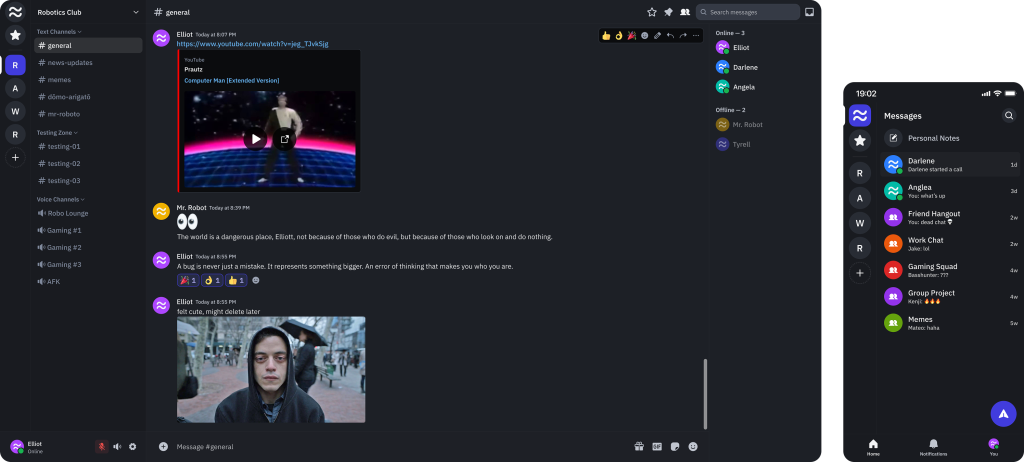
At a functional level, Fluxer covers practically everything one expects from Discord: real-time messaging with typing indicators, reactions and nested replies; voice and video calls in communities and direct messages with screen sharing; link previews, image and video attachments, and GIF search; communities with text and voice channels organized in categories with granular permissions; custom emojis and stickers. And above all, the ability to deploy it on your own server with total control over the data and without depending on anyone.
Native mobile apps for Android and iOS and server federation are on the roadmap as absolute priorities, although they are not currently available. It should also be noted that the development environment only works with devenv (based on Nix), which can be an entry barrier for those unfamiliar with that ecosystem.
Advantages and disadvantages of Fluxer compared to Discord
Among the advantages of Fluxer is the obvious: it’s free, it’s auditable, you can host it yourself, there’s nothing behind a paywall in self-hosted deployments, and the code is under AGPLv3, which requires that any distributed modification also be free. Using Erlang/OTP for the real-time gateway is a very solid technical decision. I know more than one person who programs in Erlang and it’s not an easy language, highly recommended for the world of communications, but not easy at all. And that it already works in production with more than 125,000 users gives a certain confidence that it’s not just a weekend project abandoned the following month.
On the negative side, the team itself warns that the stack is not lightweight and that self-hosting is still not at its best —they are in the middle of an important refactor and have explicitly asked that people not attempt to set up their own deployments yet—. Without native mobile apps and without federation, there is a real functional gap compared to Discord. And depending on a two-person team to maintain something with 125,000 users in production is a risk that any system administrator should take into account before migrating their community.
Discord asks for ID: the underlying problem
And here comes the part I wanted to write from the beginning.
Discord has been taking steps for years that many of us didn’t expect from a platform that started as a tool for gamers. First came the aggressive monetization, then the changes in terms of service, and now, in February 2026, the announcement that finally lit the fuse: Discord has started requesting identity verification through a photo of a government-issued ID in certain cases. Not to all users, not always, but enough for the community to notice and for projects like Fluxer to see their attention multiplied overnight. In fact, the Fluxer developer himself mentions in the README that Discord’s announcement in February changed his plans and accelerated the work.
The growing need to control who is behind each account is something that, on one hand is necessary and on the other is a complete failure as a society that we have come to build an Internet so wild that it is a danger to many people (minors, people who receive all kinds of comments without a minimum of self-censorship, manners or decorum,…)
This is not a problem exclusive to Discord. It is a pattern we are seeing across the entire industry: platforms that start as open and convenient tools, gain a critical mass of users, and then, once they have a monopoly on the conversations and communities of millions of people, start setting conditions. First they ask for an email address, then a phone number, then a payment method, and now a government ID. Each step seems reasonable in isolation. Taken together, it is the systematic construction of a centralized identity system that the company controls and on which you depend if you want to keep talking with your community.
The argument always given is security, child protection, the fight against spam. And there’s some truth to that. But there’s also the fact that having verified identity data of tens of millions of users is an enormous commercial asset. And when that data is in the hands of a private company with almost no effective regulation, the question “what if they misuse it one day?” stops being paranoia and becomes basic prudence.

Fluxer versus other open source alternatives to Discord
Matrix/Element is the most mature and federated option: it allows different servers to communicate with each other, has clients for all platforms, and has a huge community. Its weak point is that the user experience is far from the comfort of Discord, and setting up your own server can be complex. It is the best choice if federation and interoperability are priorities.
Revolt is perhaps the project most similar to Fluxer in philosophy: it is also a visual clone of Discord, free and self-hostable. It’s lighter and has been in development longer, but the pace of updates is slower and the community, while active, is smaller. A valid alternative if something more stable than Fluxer is needed at this time.
Rocket.Chat targets a different profile: it is mainly designed for work teams and companies, with integrations, customer service flows and advanced collaboration features. It doesn’t replicate the Discord experience as directly, but it’s the most robust option for corporate environments that want to self-host their messaging.
Compared to all of them, Fluxer stands out as the one that most faithfully replicates the Discord experience —interface, communities, channels, permissions— with the least functional compromise. The price is that it is still in active stabilization.
Is Fluxer a good alternative to Discord?
Fluxer, with its imperfections and still-in-development state, exists precisely because there are people who prefer to take on the technical complexity of self-hosting their own messaging server rather than handing their ID card to an American company. And that, although it sounds exaggerated, is a completely reasonable position in 2026.
If Discord had remained what it was five years ago, Fluxer probably wouldn’t exist, or at least not with this urgency. Free software doesn’t usually arise from nothing: it arises from necessity, from weariness, or from someone deciding there’s a line they don’t want to cross. In this case, I think all three things go together.
For now, Fluxer deserves to be on the radar of anyone who manages online communities, works with remote teams, or simply doesn’t want to depend on a company deciding tomorrow that they need more of your data to “improve security”. There are other open source alternatives to Discord on the market —Matrix/Element, Revolt, Rocket.Chat—, but Fluxer is the one that most directly aims to replicate the Discord experience without compromise, and with the momentum of a rapidly growing community.







Join the Sinologic community
Create your free account and join the conversations about VoIP, Asterisk, Kamailio and IP telephony.
Any advice for others?
The best articles are born from good discussions.