



3CX puts its foot down and modifies its licensing model
The other day, while talking to a colleague, he mentioned that 3CX had announced a change in its licensing system that could make them a lot of money—so much so that it breaks the main advantage it had over traditional PBXs: the licensing model.
Currently, 3CX charges based on the number of Simultaneous Calls (SC). This means if you have a phone system that needs 8 simultaneous calls, you pay based on that amount regardless of how many extensions you have. You could have 400 extensions, but if you never have more than 8 calls at once, the user pays the minimum. This is a huge advantage for many businesses: hotels, factories, shopping malls, etc. In many places where I’ve seen 3CX, I didn’t quite understand how it could be cost-effective until it was explained to me that a hotel with 400 extensions that barely makes any calls only pays the minimum for their PBX.
The industry standard is to pay per available extension, whether it’s a hotel, an office, or a large corporation. If you have 40 extensions, you pay for 40 licenses. (This is how all proprietary commercial PBXs work), and that is exactly where 3CX was miles ahead of the competition.
In short: Until now, 3CX allowed a technically “unlimited” number of extensions, although there were always recommended usage guidelines. The new policy establishes a strict limit on extensions based on the size of the Simultaneous Call (SC) license.
Starting April 1st (April Fools’ Day), they will strictly enforce a ratio of 5 to 8 extensions per simultaneous call. For example, if you need 400 extensions, you will now be forced to contract 96 simultaneous calls. As a result, the client will go from paying €350/year for 8 SCs to €4,500/year.
According to 3CX, the implementation will be gradual to give administrators time to adjust:
- Since Update 8 (V20): The system displays informational messages if the limit is exceeded so that the administrator can identify and delete inactive users.
- January 1, 2026: When renewing licenses that exceed the limit, a warning will appear in the ordering system indicating that during 2026, the license must be upgraded or extensions must be reduced.
- April 1, 2026: Official enforcement begins. Systems still in violation will have a grace period, but if they are not corrected, they could lose access to technical support.
Below you can see the table with the new pricing for calls and extensions to be applied starting April 1st:
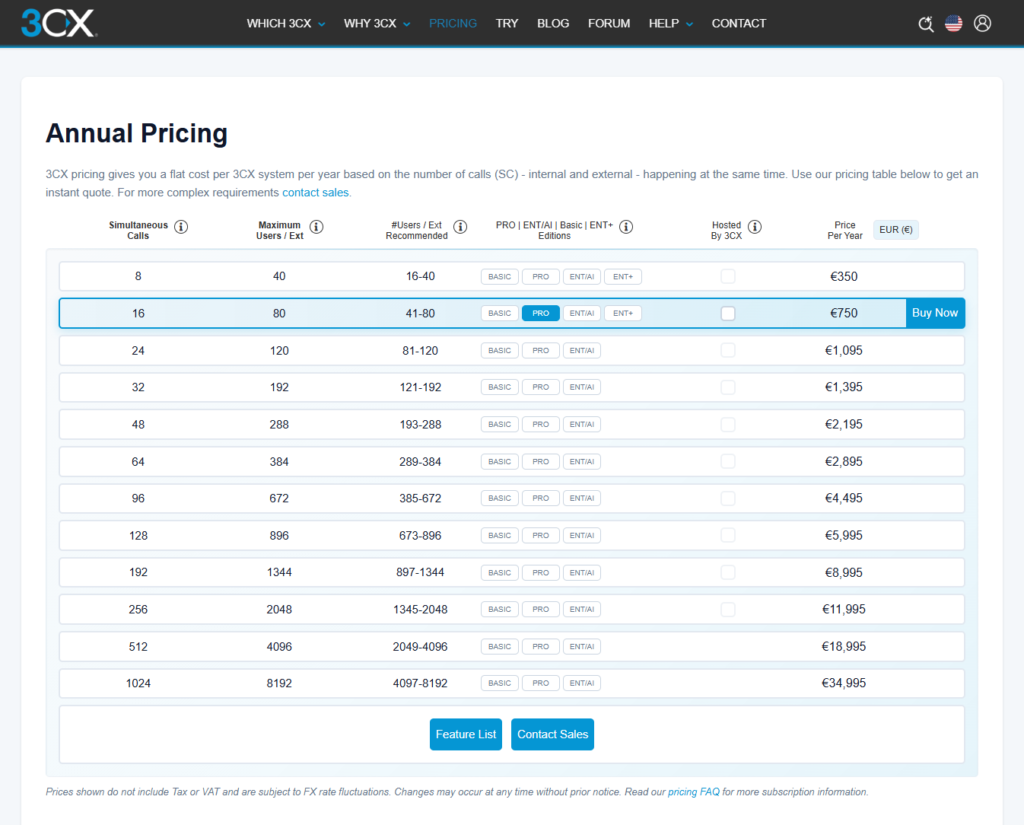
It goes without saying that, according to the company, fewer than 15% of customers exceed these limits and will not pay more. However, I can tell you that—at least in Spain—the typical ratio in companies is usually 1:8 (1 simultaneous call for every 8 extensions) in businesses with high call volumes (excluding, of course, call centers or contact centers). For companies that use the phone frequently, the ratio imposed by 3CX is significantly lower than this (1:5). What 3CX presents as a “fair use” measure to “formalize” limits and avoid price hikes reads very differently from the IT administrators’ trenches. It is, in essence, a mid-game rule change that penalizes growth and efficiency.
I could understand this policy if the maintenance were being handled by a service provider that has to dedicate more resources to a client with 400 extensions compared to one with 50. More hardware, more staff, more potential issues, more interruptions, more support queries, etc… but what does it actually cost the developer?
If a company bought a 16 Simultaneous Call (SC) license because its 200 employees rarely talk on the phone at the same time, they weren’t “abusing” the system; they were using it exactly as advertised. Now, under the new rule (a 1:5 ratio for that license), they are only allowed 80 extensions. 3CX’s solution? “Clean up your system” (delete employees) or “Upgrade your license.”
The “Maximum Extension Policy” is a bitter reminder that in the world of Software as a Service (SaaS), “unlimited” is just a marketing word until the provider decides it is no longer profitable. 3CX has decided that the loyalty of its larger customers is less important than forcing a new revenue stream through mandatory upgrades.
While I can’t speak for other countries, I know more than a few people in Spain who are already thinking about moving their clients out of the 3CX ecosystem and into a different one. That said, if those alternatives continue with the same policy of unlimited extensions while only charging for simultaneous calls—unless they are open-source—I suspect their days may be numbered as well…