


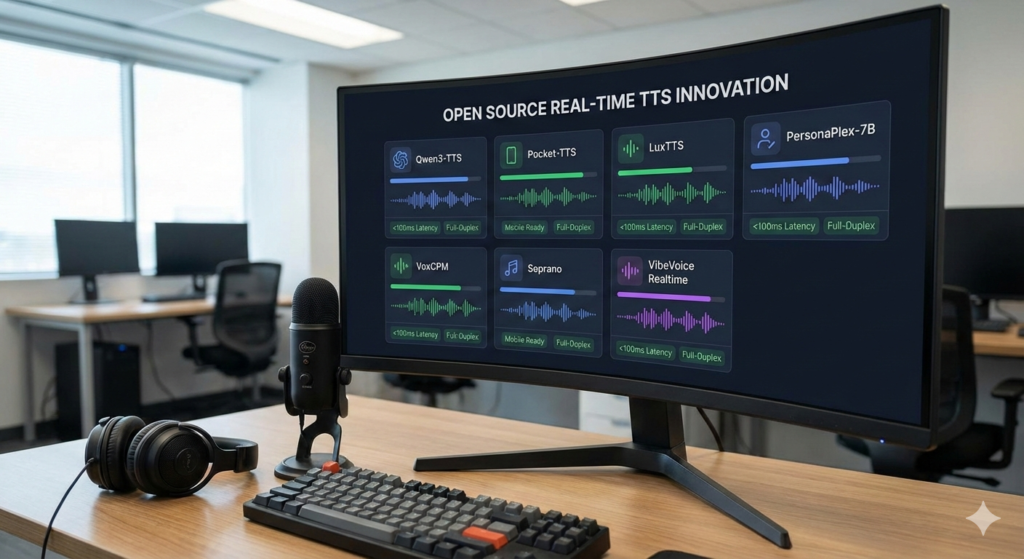
Until just a few months ago, the “sound barrier” in Artificial Intelligence wasn’t fidelity, but latency. We could generate voices indistinguishable from humans, but the waiting time (the “thinking” phase) made fluid conversation impossible. Microsoft broke the ice with its sub-100ms system, but the Open Source community has responded with staggering speed.
In less than a month, a vast number of high-quality TTS systems have popped up like mushrooms. These are oriented toward telephony, featuring extremely low latency and characteristics that would surprise anyone.
The best part? ALL of them are open source with free licenses, so it’s simply a matter of testing them one by one to discover which fits our needs best.
1. Qwen3-TTS: Multimodal Integration
Qwen3-TTS stands out as the offshoot of a powerful LLM (Large Language Model) architecture, allowing it to understand context before uttering the first syllable.
- Audio Quality: 24kHz (High fidelity with human textures).
- Voice Cloning: Yes. Supports fast (Zero-shot) cloning with just 3 seconds of reference audio.
- License: Apache 2.0 (Commercial use permitted).
- Pros: Incredible contextual understanding and support for 10 languages.
- Cons: The base model is heavy; it requires a decent GPU to keep latency below 100ms.
- Link to Qwen3-TTS
2. Pocket-TTS: Power at the Edge
From Kyutai Labs, this model—with only 100M parameters—is the king of efficiency.
- Audio Quality: 24kHz (Surprising for its size; competes with models 10x larger).
- Voice Cloning: Yes. Supports zero-shot cloning with 5 seconds of audio.
- License: MIT (Highly permissive).
- Pros: Runs on CPU and mobile devices without breaking a sweat. 100% private (offline).
- Cons: Currently heavily optimized for English; multilingual support is more limited than in Qwen3.
- Link to Pocket-TTS
3. LuxTTS: The Speed Beast
If you need to process hours of audio in seconds, LuxTTS is what you’re looking for.
- Audio Quality: 48kHz (Professional studio quality, crystal clear audio).
- Voice Cloning: Yes. Supports cloning and multiple speakers.
- License: Apache 2.0.
- Pros: Speeds of up to 150x-200x real-time. Ideal for mass content generation.
- Cons: Being so optimized for speed, emotional expressiveness is somewhat flatter compared to Soprano or VoxCPM.
- Link to LuxTTS
4. PersonaPlex-7B: NVIDIA’s “Full-Duplex”
This isn’t just a TTS; it’s a conversational system capable of listening while it speaks (barge-in).
- Audio Quality: 24kHz (Uses the Mimi codec).
- Voice Cloning: Yes. Allows defining the agent’s voice via an audio sample.
- License: NVIDIA Open Model License (Allows commercial use under NVIDIA’s terms).
- Pros: Enables natural interruptions. It’s the closest thing to talking to a human over the phone.
- Cons: Extremely high hardware requirements (24GB+ VRAM recommended).
- Link to PersonaPlex-7B
5. VoxCPM: The King of Zero-Shot Realism
A model that moves away from traditional “tokens” to model the voice continuously.
- Audio Quality: 24kHz (v1.0) and up to 44.1kHz (v1.5).
- Voice Cloning: Yes. A specialist in capturing not just timbre, but accent and emotion.
- License: Apache 2.0.
- Pros: One of the most faithful cloning systems in the current open-source market.
- Cons: The diffusion architecture can be slower on older GPUs.
- Link to VoxCPM
6. Soprano: The Acoustic Gem
Targeted at those seeking a voice that “captivates” through its clarity and rhythm.
- Audio Quality: 32kHz (Highly balanced between weight and fidelity).
- Voice Cloning: Yes, via fine-tuning with their Soprano-Factory tool.
- License: Apache 2.0.
- Pros: Ultra-low latency (<15ms on GPU) with extreme naturalness.
- Cons: Cloning is not as instantaneous as in VoxCPM; it requires a short training process for optimal results.
- Link to Soprano
7. VibeVoice Realtime (0.5B): The Reference Standard
Microsoft’s bet to prove that a small model (0.5B) can sound incredibly good.
- Audio Quality: High Fidelity (Based on next-gen diffusion).
- Voice Cloning: No (In the Realtime 0.5B version). It uses voice presets optimized for latency. Cloning is reserved for the 1.5B and 7B models.
- License: MIT (Though model weights are often released under Microsoft research licenses).
- Pros: Total stability on long texts and top-tier latency (~300ms initial response).
- Cons: Limited to a single speaker in its fastest version.
- Link to VibeVoice-RT
A Final Reflection: The Double-Edged Sword
Regarding this flood of TTS models—most of which allow voice cloning with a sample of barely 3 seconds (seriously, with 3 seconds of audio, they can clone you)—it is perhaps time to consider the risks. While the functional advantages are massive, fraud is also set to skyrocket.
Voice identification may soon cease to be a valid authentication system. If a “known” person calls you asking for a wire transfer or a mobile verification code, there are now plenty of reasons to be suspicious.
We are heading toward a serious debate: where are we going, what do we want to achieve, and will it truly benefit society if anyone, without any training but a strong desire for profit, can exploit AI for things of “questionable legality”?
Meanwhile, at Sinologic, we continue to be amazed by the innovations appearing daily, watching where this boom of “thinking cards”—which we will eventually have to pay for—takes us.